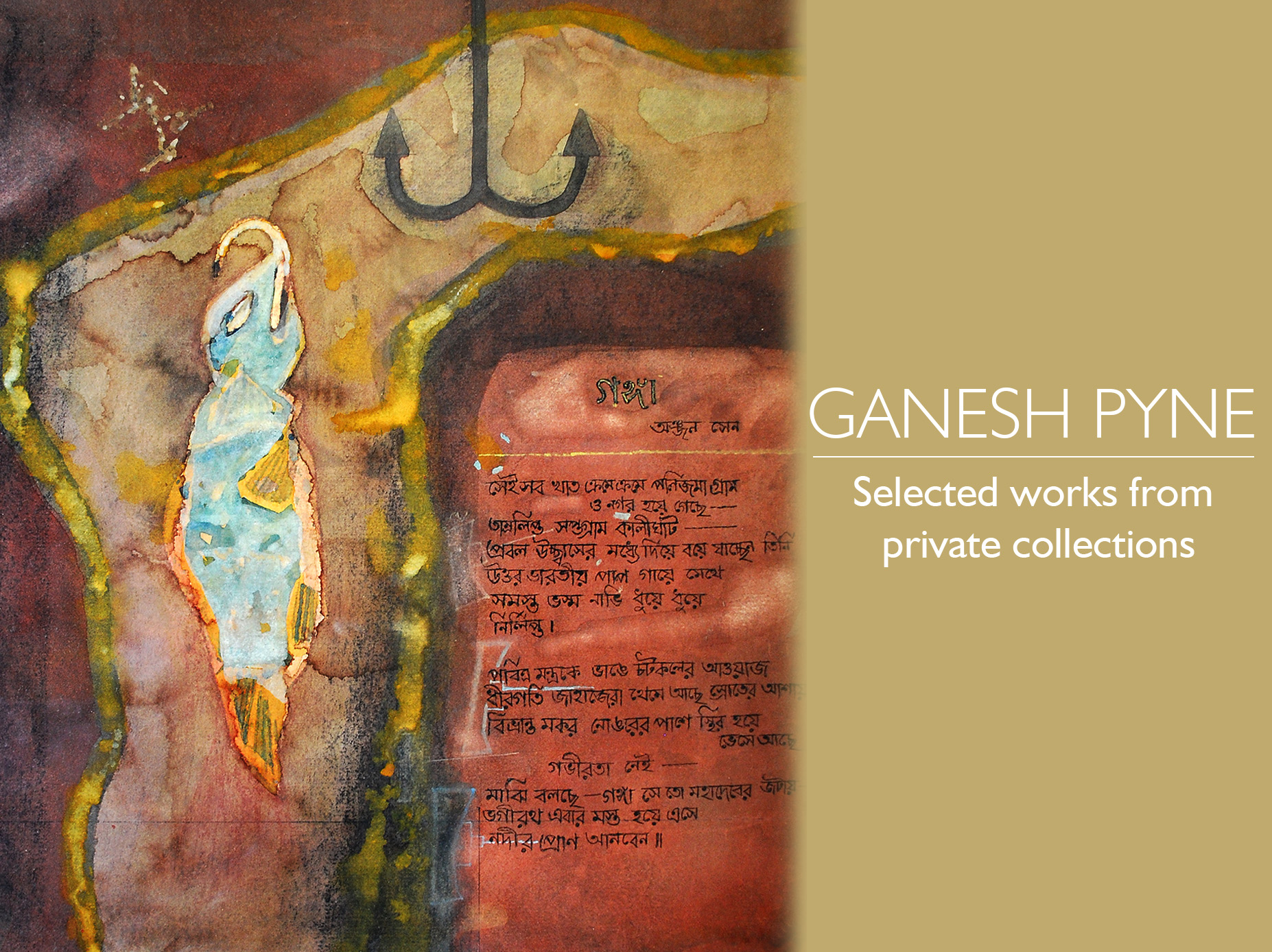
We are celebrating the eighty-ninth birth anniversary of the renowned artist Ganesh Pyne, and it is both an honour and a privilege to present an exhibition of his artworks. The occasion offers a moment to revisit his extraordinary artistic legacy. Curating the show provides me with an opportunity to reflect on my own experience with the artist and his work. My first meeting with Ganesh Pyne came through a remarkable stroke of luck. As I was beginning my life as a curator and presenting my first show, I was introduced by Biren Kaka (Biren Das) of K.C. Das to Dr Barin Ray, who happened to be Pyne’s dentist. When I expressed my wish to meet the artist, Dr Ray kindly arranged a visit to his studio.
The memory remains vivid. As I stepped into the studio, I found Pyne at work, carefully painting the graceful form of a swan. To witness him painting in real time was an extraordinary experience, although at that stage of my life, I had not yet developed the eye to fully appreciate the depth and complexity of his art. It was only with time that I came to understand the magnitude of his achievement, the mastery hidden within subtle details, the quiet intensity of his imagery, and the profound emotional and philosophical layers embedded within his works. I was fortunate enough to flip through his personal diaries and sketchbooks. The opportunity to work on the publication “Priya Lalu, Iti Ganesh: Postcards from Ganesh Pyne to Lalu Prasad Shaw (1958–1968)” offered an intimate glimpse into a lesser-known aspect of the artist’s life. These postcards were far more than correspondence; they were visual conversations, each carrying illustrations that reflected the ideas, humour, and artistic exchanges between two young artists. Through them, one witnesses Pyne as a student, navigating that crucial transitional period when an artist is still searching for a distinctive voice and language.
His journey reveals how deeply rooted he was in History and Sanskrit. However, Pyne never abandoned his Bengali identity; rather, he embraced it with remarkable conviction. The consciousness of being Bengali permeates his art. Through a unique synthesis of philosophy, memory and modernist sensibilities, he created a visual language entirely his own. Within his works, one may identify the plays of light that one finds in artists such as Paul Klee and Rembrandt, yet Pyne’s artistic vision remains unmistakably personal and deeply grounded in the cultural landscape of Bengal. His artistry cannot be confined to a few words. Whether in his tempera paintings, pen-and-ink drawings, or watercolours, there is a constant spirit of experimentation and discovery. His studio seemed less a workspace and more an artistic laboratory, a place where ideas, materials, and techniques were continuously tested and transformed. For an artist of his generation, this level of introspection and sustained experimentation was revolutionary. His practice possessed an almost meditative quality, driven by a lifelong pursuit of artistic truth. There are moments when Pyne’s works evoke for me memories of standing before the reliefs of Angkor Wat in Cambodia, where scenes from the Kurukshetra unfold across ancient stone walls. His images possess a similar sense of timelessness and layered narrative. Looking at his art has never been a passive act; it has always demanded contemplation and understanding.
One work that remains especially unforgettable is his portrayal of Chaitanya Mahaprabhu. Rather than merely depicting a historical figure, Pyne captures an essence, an embodiment of spiritual awakening, devotion, and philosophical depth. In doing so, he achieves something rare. He transforms portraiture into a profound meditation on Bengal’s cultural and spiritual heritage. The works presented in this exhibition carry that same essence. Alongside his paintings, the exhibition also highlights his illustrations, offering insight into an important formative period of his life. These drawings and watercolours reveal an artist in transition, a young practitioner driven not by materials or circumstance but by an irrepressible need to create. They remind us that artistic practice begins not with perfection but with persistence. An idea finds its way onto whatever surface is available; the medium becomes secondary to the impulse to express.
These early works reveal the innocence of beginnings and the gradual evolution of an artistic vision. They show how sustained practice shapes an artist over time, allowing the artist within to emerge fully. In the scratches of Ganesh Pyne’s works, that journey has resulted in one of the most distinctive and influential artistic voices, spreading from the narrow alleys of North Kolkata to the different corners of the World.