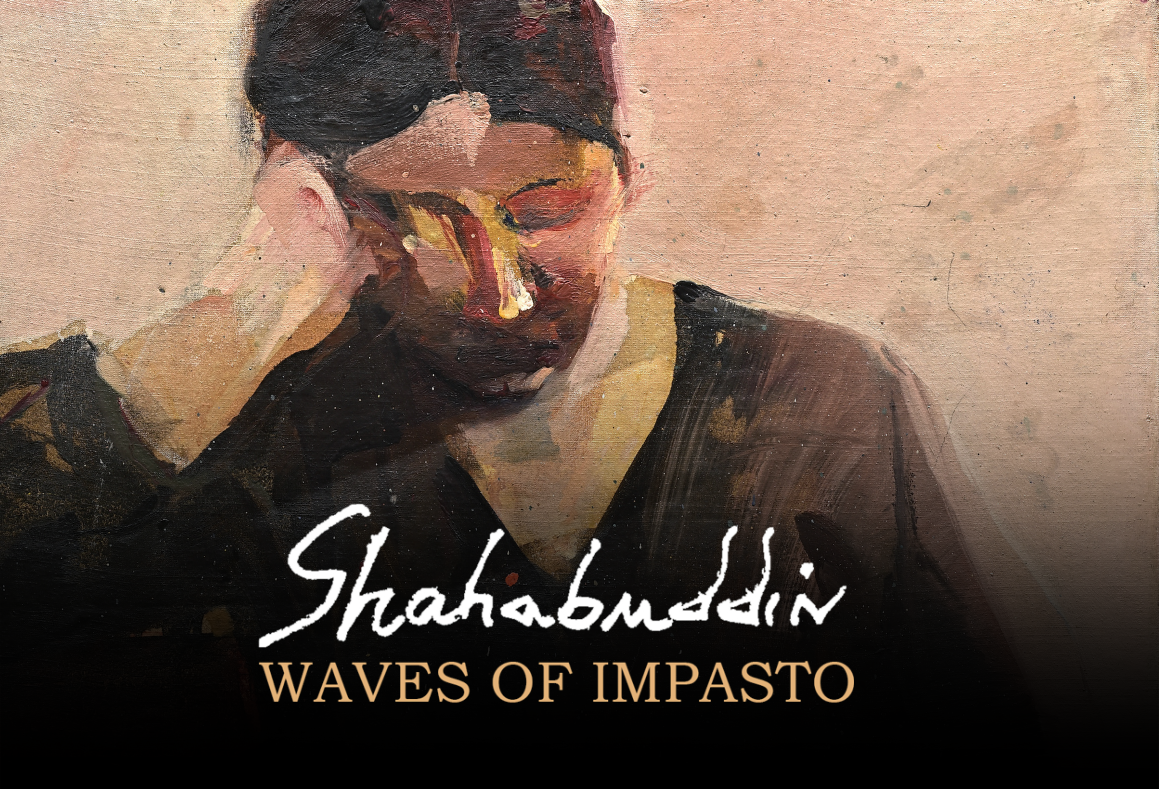
In 2015, I was fortunate enough to visit Switzerland to witness the works of the great master artist Paul Klee. The trip was especially meaningful because I was accompanied by Manu Parekh, Madhvi Parekh, and my wife, Debalina.
We arrived in the vibrant city of Geneva. On our first day, my wife and I were exploring the charming alleys when we stumbled upon an art gallery featuring an exhibition. Intrigued, we decided to go inside, and we were instantly captivated by the artworks on display. I had only ever seen these pieces in books, but now they were right in front of me. The works belonged to none other than an artist I greatly admire, Shahabuddin Ahmed.
Even now, I find it difficult to fully express the emotions that overwhelmed me as I walked into that gallery. The exhibition consisted of paintings featuring static figures, yet they captured a sense of movement.
Within the crowd of unnamed figures stood these three towering figures of human civilisation: Gurudev Rabindranath Tagore, Mahatma Gandhi, and Bangabandhu Sheikh Mujibur Rahman. The vision I witnessed that day in Geneva has never left me. From that very moment, I made a silent promise to myself that one day, I must meet with this renowned artist.
That opportunity arrived exactly four years later. On the occasion of the centenary celebration of Kala Bhavan in Santiniketan, a workshop was held at SSVAD at the initiative of my friend Prashant Tulsyan. At the request of Jogen da (Jogen Chowdhury), Shahabuddin Ahmed came to attend this workshop. It was the first time I saw the artist in person. I watched him paint from close quarters. What struck me most was that his art was never merely an expression of mood or emotion. Every stroke carried within it the history of an indomitable human struggle. His paintings were not simply made of colour; within every line and stroke, one could sense the strength of human flesh and smell of sweat carrying humanity in itself.
If I were asked to describe Shahabuddin Ahmed in a single word, I would just say “True Bengali.” To understand the depth of that identity, one must turn to the pages of the Bengal Renaissance. Shahabuddin is one of the fearless inheritors and bearers of the legacy of Raja Rammohun Roy and Ishwar Chandra Vidyasagar. Yet his art transcends geography and time. It recognises neither borders nor divisions. His paintings speak of the momentum of history itself, rising above caste, creed, and religion to tell the story of the ordinary human being repeatedly humiliated, trampled, and oppressed throughout history, yet never defeated.
As a young student, Shahabuddin Ahmed joined as a platoon commander in the Liberation War of Bangladesh as a freedom fighter. Later, he graduated from the Faculty of Fine Arts at Dhaka University in newly independent Bangladesh, before moving to Paris to study at the École Nationale Supérieure des Beaux-Arts. Paris broadened his artistic language and sharpened his vision, but his heart has always remained on the banks of the Padma River. As a successor to the artistic lineage of Chittaprosad Bhattacharya, Zainul Abedin, and Somnath Hore, Shahabuddin’s style has evolved over time, yet his sensibility has remained unwavering. In the early years of his emotionally charged artistic journey, he worked with whatever materials were available to him. Through those works emerged the pain, joy, love, and struggle of everyday life, as well as the story of his own inner search. It was through this relentless quest that he forged a language entirely his own.
Among the artists who deeply influenced him, Zainul Abedin came first, followed later by Francis Bacon. Yet Shahabuddin never remained confined within these influences. His artistic journey has always been propelled by a restless search for the new. Again and again, he returns to the figure of the indomitable human being, ever-energetic, undefeated, impossible to imprison within the rigid structures of time. Within the human figures that surge through his paintings, the artist himself remains hidden. His works are far more than layers of paint and brushstrokes. Pouring his entire body and soul into the canvas, he creates nameless warriors who seem to embody humanity’s eternal struggle. Even today, I feel that Shahabuddin himself continues to fight.
But his struggle is no longer confined to the battlefield. It unfolds across the vast terrain of human existence, abstract, profound, and deeply universal. Through dynamic movement and powerful forms, his art pushes forward relentlessly, overcoming every obstacle in its path. The closer I have come to know Shahabuddin Ahmed, the deeper my admiration has grown. I have discovered in him a man of extraordinary simplicity, yet unwavering determination, a man who does not know how to surrender. This eternally optimistic artist has poured himself completely into his creations. His paintings stand as enduring testaments to human civilisation's resilience and hope.
This struggle is not waged on battlefields or public squares; rather, Shahabuddin’s dream-weavers are engaged in a fight to uphold the dignity of the human spirit, a struggle characterised by a dynamic leap that surmounts every obstacle. And it is amidst the wind-swept Kash ful (Wild Sugarcane flower) that he discovers this very essence.
And in every troubled corner of this vulnerable and struggling world, the figures in Shahabuddin’s paintings seem to ask humanity the same question that Rabindranath once asked —
‘যাহারা তোমার বিষাইছে বায়ু, নিভাইছে তব আলো,
তুমি কি তাদের ক্ষমা করিয়াছো? তুমি কি বেসেছ ভালো?’
(‘Those who have tainted your air, extinguished your light
Have you forgiven them? Have you loved them?’)